Showing posts with label Khartoum. Show all posts

Thursday, July 10, 2014

5 Ramadan Myths Busted


Based on my brief Ramadan experience

Obligatory waiting in traffic amjad selfie
I wanted to write at least one more post about what my life has been like since Ramadan started because I thought it’d make for an interesting post. Ramadan is a holy month in Islam where people fast during the day time for 30 days. Fasting is from sunrise to sunset; no food or drink, not even water. This year’s started off with some major confusion surrounding when it actually started. You see the Islamic calendar relates with the moon’s cycle. So for weeks I’ve been asking when Ramadan started and gotten different answers. I must have received no less than 5 contradicting messages from people the Saturday before it started. “Google says..” quoted one non-Muslim friend. Well Google was wrong.

Let’s look at some other Ramadan in Sudan myths and misconceptions. And by myths I mainly mean the wrong assumptions I made about Ramadan before I knew better.

Everyone is fasting. WRONG For starters children and elderly don’t fast. Some families have kids “practice” a day or two as they get older. If you are traveling or sick you also don’t have to fast. (Shouldn’t this have ended the World Cup Muslim players fasting controversy?)  When girls are on their periods they don’t fast. Although they have to “make-up” days throughout the year before the next Ramadan (same for those who skipped due to traveling). In the end, fasting or not fasting is a personal decision.

Everything shuts down during Ramadan. WRONG I think I got this idea from the fact that on Fridays everything closes for people to go Mosque. I told some friends that I was planning on doing a big shopping trip before Ramadan started to hoard food. They looked at me and started laughing and then told me stores would still be open. While some stuff is closed, a lot more is open than I thought would be. Groceries and little shops all stay open. Schools running classes (like mine) stay open. We were really surprised to still have good attendance this past week. Restaurants open at night. The buses still run. Life continues as normal. If you have a job you still have to go to work.

The hardest part about fasting is not being able to drink water. WRONG Well, maybe for some it is the hardest part, but a general survey of complaints has yielded many more about smokers being antsy wanting a cigarette or coffee-drinkers with headaches from being unable to get their caffeine-fix.

People lose a lot of weight during Ramadan. WRONG Well again, I don’t have scientific evidence on this but I recently saw this article. Overeating is apparently a big problem. Some people try to take 4 meals in the span from 7:30pm-4am. I can’t imagine working out or running in Sudan when I could drink water (although there are gyms and clubs which residents frequent) but its safe to say during Ramadan the physical activity is even more limited.

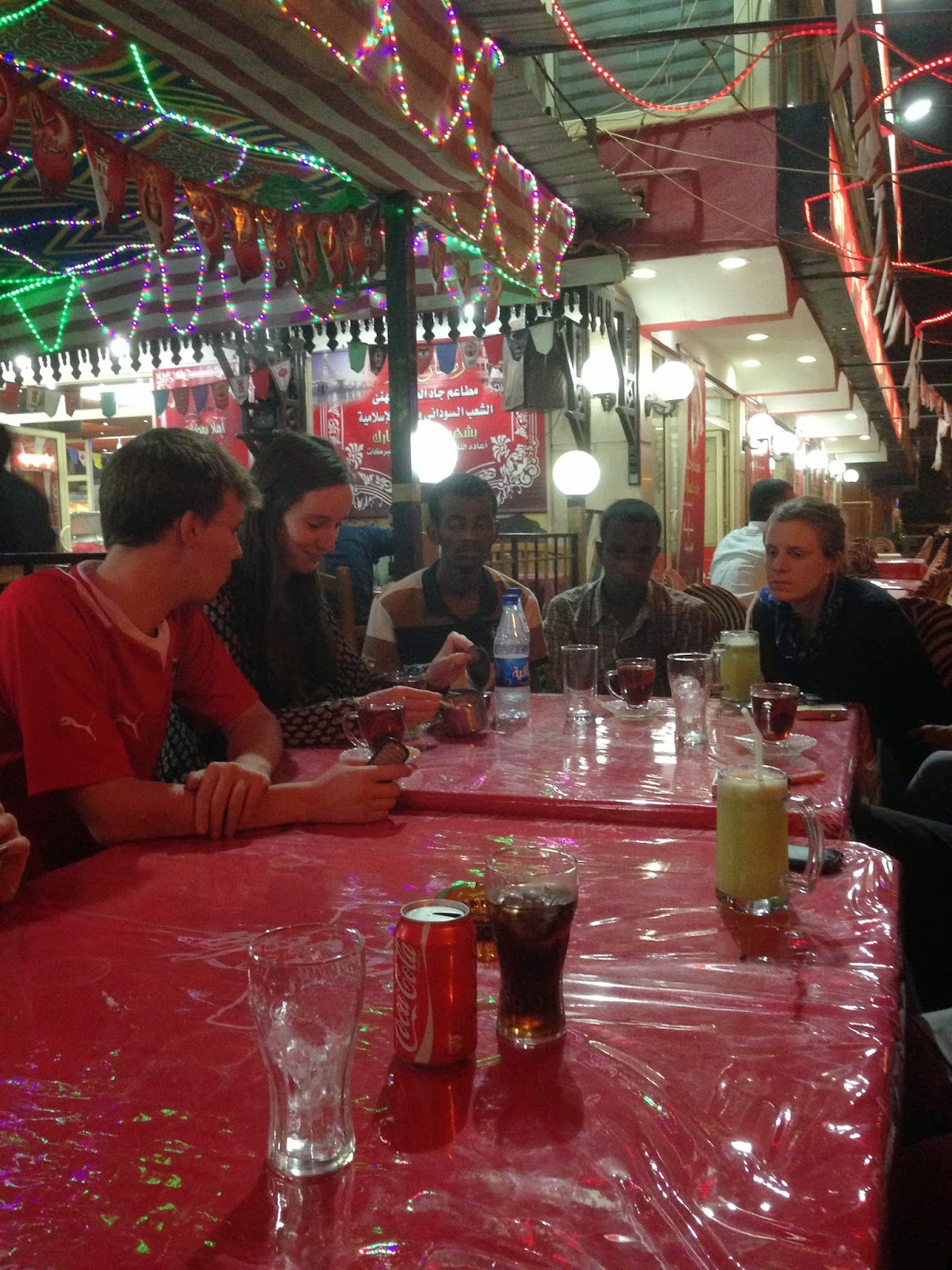
It’s going to be really challenging to feed myself during Ramadan. WRONG Since Ramadan has started I think it’s actually the best I’ve eaten in the last 4 months. Since our usual cafeteria and fast food lunch places aren’t open and due to general interest, I’ve really taken up cooking a lot more meals. And no I don’t mean Ramen noodles. I’ve made some great lentil and chickpea soups and salads and then used the leftovers to make my own falafel (sans food processor BTW). I literally whipped up dinner for my entire household two nights last week. WHO AM I? The second part of eating awesome during Ramadan has been the amazing Iftar dinner’s I’ve been invited to. Iftar is the meal around 7:30 here that breaks the fast. There are some special foods eaten for Ramadan and the meal is always taken on mats on the floor. Dates and ful ( slow cooked fava beans) are a must.  I think the most important ingredient in an Iftar “breakfast” is the whole family or community coming together. Many families eat outside in the streets. The purpose of this is so if any traveler is passing during the time fast breaks they can be invited to join.


Outside our window at  4pm vs at 7:30pm. You can see the tea ladies' chairs stacked in the parking lot during the day. They set up right before fast breaks. You can see in the second picture the groups of men eating on mats on the side of the street. Some days we can see as many as five different groups just from our back window.

Above and below are examples of Iftar meals. They both include some Sudanese signature items like dates and ful. Above also includes moola and garassa which I've discussed previously, salad, and powder sugar covered zalabiya for dessert. Below in addition to ful and dates shows some yogurt dip, temiyah, salad, rice, and french fries.


After dinner we got to play with a puppy, so clearly that was the highlight of the evening.


Tuesday, July 1, 2014

Take-Aways/Sahfari*


So it’s July. I’ve made it. In 20 short days I’ll be leaving the place I’ve called home for the last 10 months. In the last month or so I’ve thought about what I’m going to “take-away” from this experience. Its even more refreshing now that some new volunteers have arrived and asked me these questions and what to expect. I’ve thought a lot about how I want to “talk about Sudan” with friends, potential employers, and strangers. I’m definitely searching for a balance.

A farm on Tuti Island overlooking Khartoum
I’ve really been thinking about the way I view and define violence, development, and freedom while I’ve been here. I hope to continue to challenge my and other’s definitions with different cultural interpretations.

Rachel and I have spent countless nights here debating lots of etymology used in International relations and development. The one we could never quite get over was “Developing vs developed country.” Although far better than the other category option of “Third-World,” I think our community of practice owes it to work out better language than this.  It’s problematic. I’m sure there have been far more articulate arguments made about this issue and I urge you to post them in the comments section below.

Some pretty terrible things happened to some people while I’ve been here. For security I’ve not shared those stories on this blog. I’m not going to whitewash those truths when I come home, but at the same time I don’t want my experience to become throwaway anecdotes which minimize some truly horrible  problems in Sudan or make it about “how rough I had it” (EYEROLL) or something that perpetuates or plays into the stereotypes of Sudan which Americans have.


Nile Street at Sunset
I think it’s very hard to simply say any statement saying “Oh well Sudan is like this…” “Sudanese people are like this” The same way when my students ask me about America and I tell them I can’t generalize about all Americans. I’m going to try to take that lesson to heart. 

Ok here are some more pics of what I've been up to this month!
Nas with notepads - a monthly spoken word event

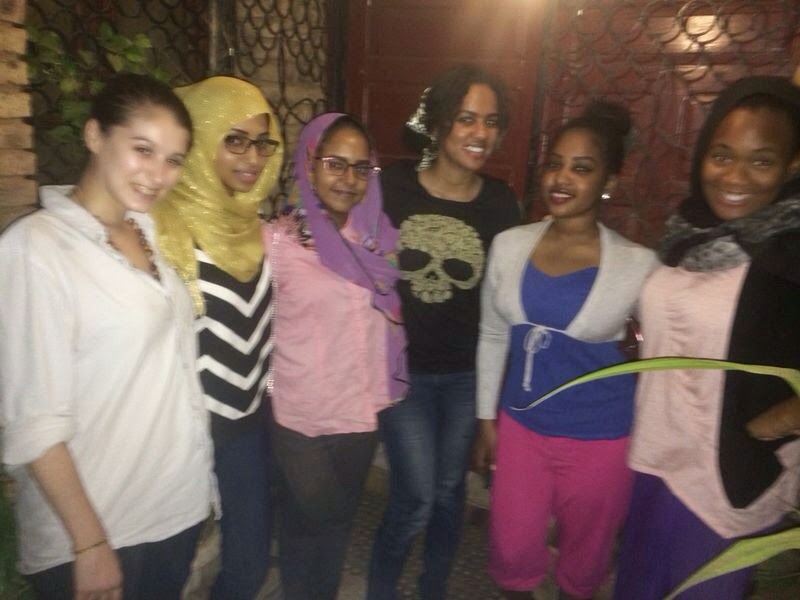
Hanging with some fun ladies for mougrib tea


Henna- a beautiful Sudanese tradition for women before they get married

One of two Mexican restaurants in Khartoum "Amigos" describes itself as Tex-mex

Goodbye dinner at GAD!


*Sahfari (Sah-FA-ri) is the arabic word that is used to get food "to-go" it means take away. Easy to remember because its like  going on a safari

Tuesday, May 27, 2014

Kassala for Beginners


"Kassala, Mashallah, Humdallah"


I feel I must backtrack and offer you all some description on my wonderful trip I took to Kassala (Cuss-a-lah) in the East of Sudan back at the end of March. Honestly I’m so incredibly grateful that Rachel and I found the time to travel.
Sunset over Kassala

Our journey to Kassala  began very early in the morning. Luckily our friend helped us navigate the bus station at Mina Burri. It was a pretty hectic scene, so we were happy to find our bus and attempt to go back to sleep. The bus ride from Khartoum to Kassala is 8 hours. The buses are large coach busses, with tvs and AC. Ours was decorated with orange fringe, fur, and beading everywhere.
We arrived and were met by our good friend and fellow volunteer who is teaching at the University of Kassala. Even though he, himself, had only shortly just arrived he would be our tour guide while we were visitng. Also another friend arrived the night before from Port Sudan.

First glimpse of Kassla on the local bus into town
The first thing I noticed about Kassala were the mountains. Beautiful rocky mountains that do, indeed have, as my guide book described, an “other-worldliness” way about them. The second thing I noticed was that it was considerably hotter in Kassala. The heat hit me like a wall getting off the bus. This was back in March too, when I was still asking Sudanese friends when it would get hot again. Well, I had my answer.

The heat was bad like, bad-bad. But the scenery and company was too good.

View of Mountains from the University of Kassala
The center of Kassala has plenty of juice stands. They were round or hexagon shaped and reminded me of touristy food or lemonade stands in beach towns. Much to our surprise Kassala seemed much cheaper than Khartoum. Not surprising was that Kassala was much smaller and had much fewer people who spoke English. I also saw people of different ethnic groups and tribes that are less present in Khartoum. Of course we saw many Beja men, dressed in their classic uniform, a jalabiya with a vest over it and Rashida women who distinctly dress in black velvety robes/gowns with red beading and their veils covering their mouths.
Teapot gated entrance to Totiel 
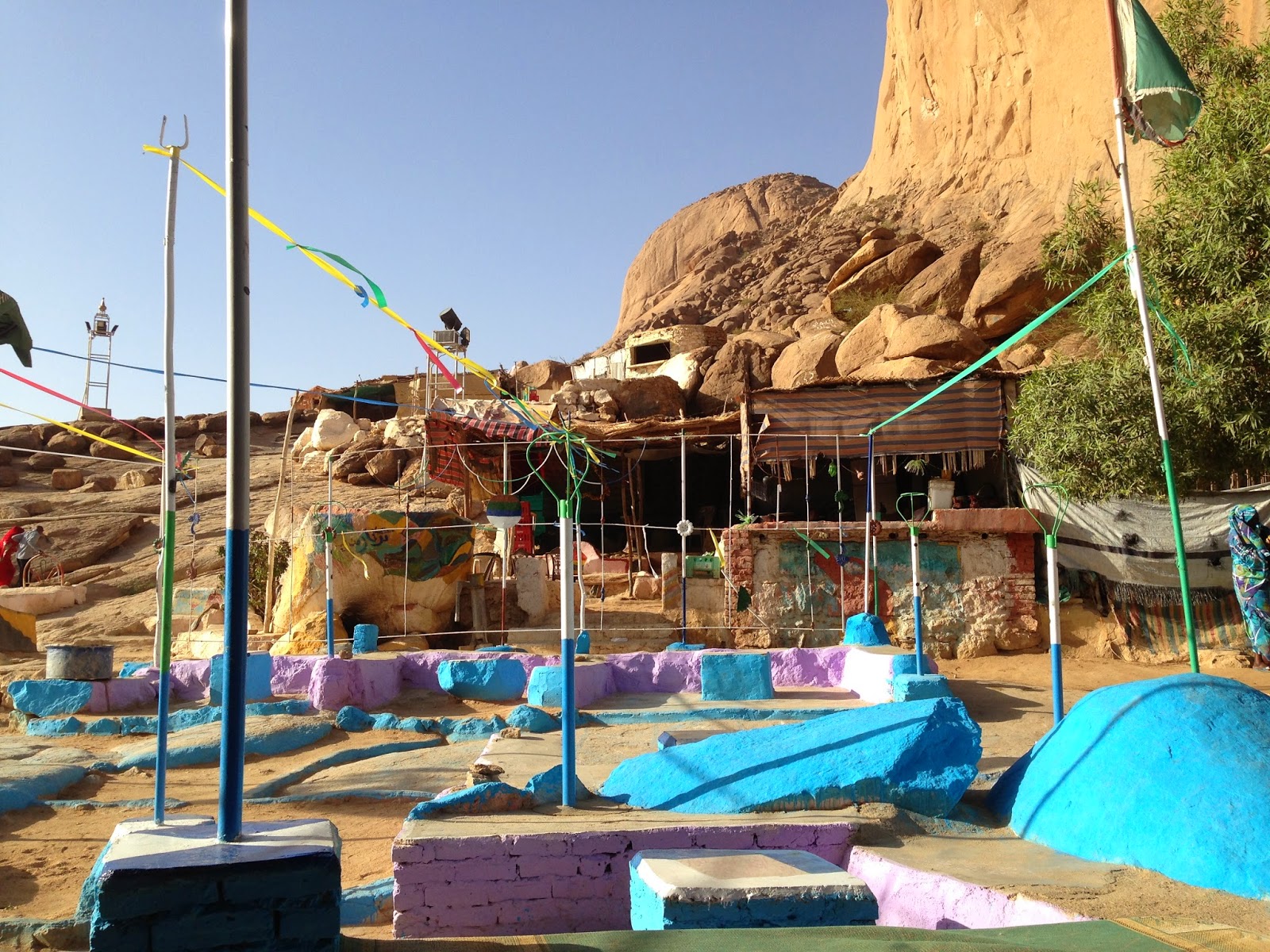
During the trip we visited Totiel, at the base of the Taka Mountains. This is a frequent spot for honeymooners and other Sudanese on vacation. Many coffee and tea huts are set up or even carved in at places at the base of the mountains. The have painted the rocks and decorated the area so it is quite festive. My favorite part of Kassala was having coffee and popcorn (served together like in Ethiopia) at Totiel while watching the sun set over the town. We also people-watched looking at the newlyweds, the women in their finest beaded tobes with beautiful henna on their hands and feet. We tried to assess which couples seemed the happiest and which women were fairing the best in their clunky wedged high heels on the mountainside. The next day the members of my group were determined to climb part of the mountain to see Eritrea on the other side. I was determined not to pass out from the heat just from being outside.* So, I passed. I didn’t pass on drinking from the well at the base of Toteil. The well is said to promise good fertility (here’s looking at you, honeymooners) and that visitors will return to Kassala.


Coffee hut on Totiel

The well
Toteil coffee huts empty which would fill with people before the sunset


How I creepily took a pic of honeymooners

The pot is called a jebana
Coffee  is also called Jebana so you order a "jebana fi jebana" served with salty popcorn and incense 
 We also visited the Khatmiyah Mosque also located at the base of the Taka Mountains.


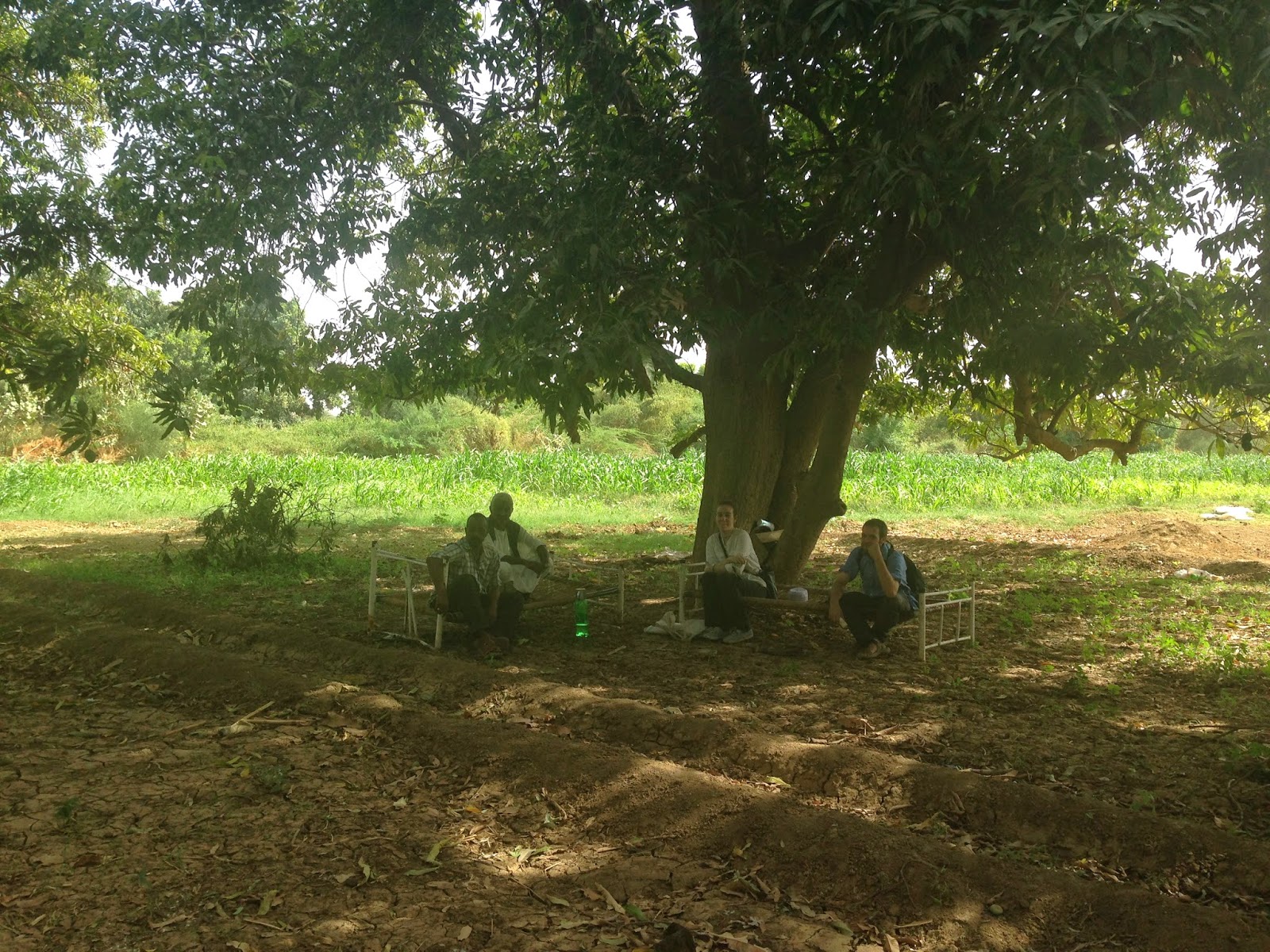
Our other time in Kassala was spent checking out different souqs (markets), parks, and walking through some mango farms to the Gash riverbed. 


Stopped to splash ourselves with water from an irrigation pump in the mango grove
 Of course when a family found us wandering around in their farm they offered us, to rest with them and their kids got us some fruit.


Overall it was a wonderful trip. Even in the heat it was nice to get out of Khartoum, explore nature, and see different cultures. I highly recommend it for anyone traveling to Sudan. 

*Also contributing was my lack of mountain climbing footwear and clothing. Have you ever climbed a mountain in a skirt? You can assume it's not a great idea. 

Thursday, May 22, 2014

Teacher Musings and How to Deal with the Heat


I realized I haven’t given a life update in some time and so it’s probably only fair to write about what I’ve been up to. A lot has happened! I moved from Bahri (Khartoum North) to Manchea*, a neighborhood in center of Khartoum. I moved because Rachel and I received a new university placement at Comboni College. We live much closer to Nile Street and “all the action” Khartoum has to offer, though we do miss the tightly-knitted neighborhood of Safia and our favorite neighbor Haj Safie at times.

Our  kitchen where our signature dish pasta and Mish** tomato sauce is made

Camboni College has a really interesting history. It was started as a primary school by missionaries but has since scaled up.  It is named after, Daniel Camboni,  the first Catholic Bishop of central Africa, who worked as an Italian missionary The school administration worked with the Ministry of Education and now offer 4 Bachelor’s programs in some sort of public/private partnership. They also offer "after-school" English, Spanish, and Italian short-term courses. There is a church at the Souq Arabi campus and all the secondary students wear lavender blouses and headscarfs for girls, with black bottoms. It is pretty amazing that their campus is located right around the corner from “the big mosque” in the center of Souq Al Arabi. Many students of all different backgrounds attend classes at Comboni. The classes I teach are short-term private classes which are small and grouped by level. They are much more manageable than my 80-100 group of rowdy 17 year olds at Bahri University. This has had a huge effect on my feelings about teaching and my spirits in general.

We haven’t been without problems, but overall the administration of the school is the most organized I’ve been involved with or potentially heard about here. Our coordinator is an incredibly bright young Sudanese woman who splits her time running the short term courses for Comboni and running an oncology clinic. She speaks fluent Italian and English and is taking Spanish courses. Honestly regardless of the frustrations we have, this woman runs a tight ship and is an inspiration.

The terrace across the street from Khartoum University where I taught my private class
I was also teaching private classes associated with Khartoum University that just wrapped up in April. If you’ve been following the politics there, I’d add it finished just in the nick of time although I’m saddened by the university’s closure. I really enjoyed this group of students. At the end of our class we even took a class trip to Jebel Aulia, about an hour south from Khartoum on the White Nile, to have a picnic of fried fish.


Students exploring the dam
Boat ride on a fishing boat by our picnic spot
We have decided to hold our own English club on Nile Street twice weekly. Nothing like having a hot cup of tea on the side of the road in 100°F heat. I can’t actually believe I got this far into discussing my life without mentioning that Summer is killing me!

A spot along Nile Street by the "India Bridge" to Bahri

Nile Street!
It’s hot hotter even hotter now. Always. There isn’t much else to say. The heat has made many of the volunteers, including myself, more anti-social. People don’t want to leave their homes, which is fair. Staying in seems to be one of the best ways to cope. I feel like I should have learned more tricks of the trade by now, but really, I only have a short list with a few of the lame ways we have coped with the heat.
1.)    Drinking water
2.)    Putting our sheets in the freezer
3.)    Standing in front of the fridge while it is open
4.)    Multiple showers daily
5.)    Drinking more water
6.)    Holding a water bottle like it’s a baby.
7.)    Naas Pizza delivery (ah-mazinggg BTW)

Like I said not a very impressive list, but hey, I think we’re doing alright, for ourselves. 


The glory that is Naas's "Ethiopian Pizza"

*Currently polling the English spelling of the neighborhood as I've seen it Manchea, Manshiya, and Manshia.

**My googleing in English failed to produce a good picture but for all intensive purposes Mish is like yogurt veggie dip

Friday, April 4, 2014

The 7 Types of People Who Volunteer in Sudan


Who Actually Goes to Volunteer in Sudan?

The following are a few traits that are true about most people who come to volunteer in Sudan:
  •          Has a genuine interest in travel or learning about different cultures than their own
  •          College educated 
  •      Doesn’t know exactly what’s next for them in life
  •          Has volunteered in the developing world before
  •          Doesn’t speak Arabic
  •          Did not wake up one morning and have some sort of epiphany about saving the world
  •          Owns a copy of the Bradt Sudan Travel Guide

Sunset over Hamed al Neel Omdurman

Declaimer: These are loose caricature profile descriptions, in real life many of my fellow volunteers have characteristics from several of these categories and perhaps some don’t fit into any of these categories, despite my catchy title. Even I don’t fit into all the statements above, this is my first time volunteering, and just because I’m able to give an outline of “who” volunteers, it is much harder to encompass “why” people volunteer. People’s motives are personal and in many cases too complex to fit into a nice short categorized description. 

Building on Tuti Island

The 7 types of people who volunteer in Sudan are as follows: 

The Arabic Student
     The Arabic student arrived to Sudan with two suitcases. One with clothes and supplies and one with books.  The Arabic student declines invitations to hang out at a pizza place with fellow ex-pat colleagues opting for meeting local friends for their cousin’s wedding (the 4th wedding they’ve been to this week). They throw Arabic phrases in all their conversations even those with their kawaja (white) friends. The Arabic student even buys a jalabiya (local dress for men) or rocks henna on their hands (local tradition for women) and doesn’t shy from talking to people in the street.

The World Traveler
     The world traveler is deeply interested in gaining a new cultural experience. The World Traveler has been a passport holder for as long as they can remember. They’ve camped in the desert, meditated with monks, and became a tour guide in Cairo. This isn’t their first time at the rodeo of working in a “developing country.”  They are interested doing the “touristy” stuff in Sudan to check items off their bucket list, and also meeting and enjoying the company of the Sudanese people. The world traveler can cook cuisine from many countries thru some creative improvisation with local ingredients and gives great small gifts from their past travels. The world traveler has great advice.

The Long-term Volunteer
     The long-term volunteer is a quirky but awesome individual.  One day he/she found an ad in a newspaper calling for volunteer teachers in Sudan and the rest is history. They can’t help themselves but keep coming back with a month trip home every couple of years. Even though they have lived here the longest they aren’t self-centered or conceited in the least bit. They are always willing to share advice, jokes, and stories. They maneuver otherwise sticky situations gracefully with a huge smile, decent Arabic, and a spring in their step.

The Recent College Grad
     The recent college grad is looking for a break, trying to push off the “real world” or seeking unemployment by choosing to come to Sudan for a “meaningful” gap year. The recent college grad probably studied international affairs, history, or anthropology.  In school they specialized in terrorism, women and forced migration, or peace studies. They would like to find work in their government’s Foreign Service, international development, or apply to a graduate program in conflict resolution. The recent college grad expected they’d be living in a hut but is cool with the modern conveniences of Khartoum.

Peter Pan
     Peter Pan is a white man who came to Sudan because he is lost. He talks about his plans to start a business, he is destined to be a social entrepreneur, but never will because then he’d have to grow up. He thinks it’s such a shame that Sudan has let itself go since the British left. Peter Pan complains about how frustrating the Sudanese culture of being late, laid back, and unorganized is but ends up acting this way as well. Peter Pan is a charmer. He fancies himself a number of things. He works the system.  He’d rather “live like a king” in Sudan. Peter Pan doesn’t want to settle down in one place just yet and probably will stay in Sudan until he secures his next gig in Thailand or Argentina.

The Ex-Corporate Lawyer
     The ex-corporate lawyer is a nonsense risk taker who decisively knew they had to make a change in their life and quit their fancy high-paying job at a law firm.  The ex-corporate lawyer is head strong and unafraid of new experiences. They went back to school and decided they wanted a job with more meaning in life. They are the “mom” or “dad” of the group planning socializing time, encouraging volunteers step out of their comfort zones, and making sure everyone is healthy. The ex-corporate lawyer has a strong moral compass and is assertive in stating their opinions. . They throw themselves into their teaching job like they would any work they had done back home,  and plan lessons extensively which can be frustrating when as happens people are late, buses take wrong turns, and classes are cancelled but their enthusiasm ensures that they make great Sudanese friends.

The Religious Person
     I don’t know much about the religious person because up to now in my short experience I have yet to meet someone who fits this profile. I do think its worth mentioning the religious person due to the numerous stories and instances of this character I’ve heard about. It seems as if the religious person is usually female, very sweet, and means well, but at times finds themselves isolated or at tension with life as a volunteer teacher in a predominately Muslim society and with the comparatively less-religious volunteers.


Khartoum Botanical Gardens 


Tuesday, February 11, 2014

The Social Scene in Khartoum: Concerts, Culture, and Dancing


Upon coming to Sudan I was warned that it doesn’t exactly have a vibrant social scene, in the traditional Western sense. I was told of course there arn’t movie theaters*, concerts are limited, and there isn’t exactly night life. My social life in Sudan has proved much of this to be quite contrary. I’ve frequented concerts, parties, and stayed out very late on Nile Street. This can’t be attributed to getting on the inside of the Khartoum expat social scene either, as Rachel and I have happily found ourselves slightly outside that circle. Rather the past couple weeks I’ve had my fair share of exposure to Sudanese culture and entertainment through several festivals. There have been really great events.


First Sudan Film Factory partnered with a number institutions including the Goethe Institute (German cultural institute) and hosted Sudan’s First Independent Film Festival. How great is this? I was lucky enough to get my name on the list for the opening night. On opening night there was a screening of “Faisal Goes West” a short film about a family who emigrated from Sudan to Texas. You can watch the trailer here because I’m about it SPOILER ALERT in my experience and review of it. I loved that the film maker chose to tell this story framing it around the struggle of immigrants and not making it about refugees. There is even a line “Darfur. Yeah we aren’t from there.” It was also super interesting to watch the film as an American in an audience full of Sudanese. In many ways America is still “a big dream” for many Sudanese who I’ve talked with. Rachel and I estimated about 3 out of every 10 Sudanese friends or colleagues have told us they applied for the lottery. The movie does have its cringe-worthy moment where Faisal runs into some guys that jump him. Obviously I don’t want my Sudanese friends to think that if they come to American they are going to be attacked or robbed and that we have become an intolerant society of outsiders in America so yeah my initial reaction was a sarcastic “oh great”. Upon reflection though I think the scene, clearly the climax of the film, speaks symbolically about the difference between perception and reality of the typical immigrant’s journey. Anyway it’s a great film you’ll laugh, you’ll cry, you’ll wonder if there really are still chicken farms in Texas.

          After the movie there was a great performance by Dina Al Wadi a French-Egyptian Singer who wore a hot pink mumu type dress. She even sang some Sudanese songs of which the crowd loved and sang along with. I think she was the most talented singer I’ve seen perform in Sudan.


          Anyway I went to an additional screening of another film though the festival screened maybe up to a dozen and generally think the film festival was a success so that’s really great. Additionally there was a Sudanese Cultural Festival hosted by the Sudanese National Museum and co-sponsored by the British Council. During this festival I attended two concerts. One showcased a local Reggae band and the following night a British Dub-Reggae Band (cause apparently that’s a thing now) performed.  I think I’ve mentioned before that many Sudanese love reggae music. At one point one of the nights hosts made the claim that reggae music started in East Africa…a claim which definitely raised an eyebrow or two. The concerts ended at 11 due to a noise curfew or something. While generally I don’t want to put down these types of events I was scratching my head a bit at the fact that a British band was headlining the final night of a “Sudanese” cultural festival. To the organizers’ credit for a few songs some local artists joined the band on stage.
It could have been an off-hand remark but my friend Mohammed turned to me during Dina al-Wahi’s performance and said that because there was such an international crowd she should sing some American music. I get the impression that Sudanese culture isn’t perceived as “special” or “good enough” and was reminded of this again with the British band incident.

     
          As far as entertainment between festival based events (and there seems to be a festival of some sort every month) there are several restaurants that have live-singers on Thursday nights. One of which is a popular Souq Al-Arabi restaurant called Papa Costas. All I can say is I’m still recovering from my experience dancing and listening to the band play everything from “Hotel California” to popularized Arabic music to a Tom Jones inspired take on “Yesterday” and I don’t think any amount of words could fully describe my night there, but it was definitely fun and unexpected.


Finally not to leave out one of the more glamorous nights out I most recently attended a very lovely party at the German residence located at a Nile front property.


*The newly opened Afra Mall has a theater showing Egyptian movies 

Tuesday, November 26, 2013

How to Ride the Bus in Khartoum


            Before coming to Khartoum I was warned about its bus system. Khartoum is a rather large city that spreads across The Nile. Walking in the heat long distances isn’t really an option. So we turn to transport to get around between neighborhoods. Amjads and taxis can be quite expensive. Rickshaws aren’t allowed to cross the bridges and aren’t allowed in certain crowded neighborhoods. And so I introduce you to the buses. With no set schedule or routes the bus system is something I’ve been cautiously attempting recently. And let me tell you I don't hate it. 
The advantages are that buses are incredibly cheap maybe just one pound for a ride. Taking two buses to Khartoum center and paying 2-4 pounds seems well worth the effort when a negotiated amjad could easily run you 30-40 pounds. Also buses run on all the major roads so finding them isn’t very difficult at all. Some guide books have attempted to detail the bus routes but I don’t think these are extremely helpful.

So how do you actually do it? How do you use the bus system when there are no written schedules, routes, and the stations are half parking lots with a few scattered signs in Arabic and half literally in the street? Well it’s not for those looking for the most efficient and timely experience, but this goes hand in hand with Sudanese culture. This being said I still think that Americans could learn a lot from the Sudanese bus system.

Disclaimer: This is from my very limited and personal experience riding a handful of the same routes a dozen or so times.

The easiest way to get a bus is at a bus station, but you can also “catch a bus” if you know gesture correctly and know where its going. Bus “stations” are very spread out sometimes even include the road and side streets. The only way to find out where the bus is that you want is to ask people. Because I don’t actually speak Arabic this normally includes gestures repeating the place, repeating places near the place, and sometimes having had a Sudanese friend write the place in Arabic on a note pad. If youre in the wrong section at “the station” someone will point you in the right direction. Often times someone will even say come with me and will ask around for you till you find the right bus. It common for people to even go far out of their way to help you. So that’s the big secret on how Sudanese navigate a bus system with many routes leaving and coming at different times…they talk to people. For someone with little Arabic this is the main challenge. Luckily, Sudanese are generally happy and patient to help.
If you’re on a major road you can catch a bus. You have to know the hand signal and listen for what the guys are shouting. Once you’re on a bus the bus attendant who stands in the doorway will snap at the front of the bus. It’s time to pay him when he snaps at you. Paying in low bills or coins is the best but I’ve seen people pay for one person with 10s 20s and even a fifty. Often times they collect all of the money before divvying out change. The process of paying by handing and passing money up and down the bus is something admittedly would never work in America, but it is refreshing that people are so trusting and honest so it works in Sudan.
There aren’t really set bus stops. To “request a stop” you snap or hiss. People snap at you to get your attention; its not rude. Even my students snap at me in class. A lot of time for men the bus won’t even come to a complete stop and the guy has to jump out.

Riding the bus has been a mix of good and frustrating experiences for me. To independently get between places without relying on a taxi feels good but sometimes it’s just not realistic. Sometimes buses just don’t go where they say or go over a different bridge than you thought. Sometimes there is no good way by bus to get somewhere. I’ve tried to adapt the Sudanese attitude when it comes to these otherwise problems…its really Ma Mushkila I know I’ll get where I need to go eventually.   I know that sometimes I have to let it go and hop in a rickshaw or amjad. I remind myself “hey youre in a foreign city” Its ok. But I do still laugh when I think about when I told a man I wanted to go to “Khartoum Itneen” (Khartoum 2) and he told me he didn’t speak English I just stared at him. “Khartoum Itneen,” I repeated.


*Note for concerned family I frequently take the bus with Rachel or a group of friends and we almost never ride after 8pm really because they stop running as frequently

Saturday, November 16, 2013

White Girl Goes to Africa, Isn't Trying to Save Anybody


Let’s get one thing straight. My experience in Sudan is entirely shaped by the privilege that I’m a white woman. This privilege has affected my time here so far both positively and negatively. It is interesting because at times socially acceptable behavior for being white and at the same time a woman are at tension with one another. Sometimes there isn’t space for being a white woman.

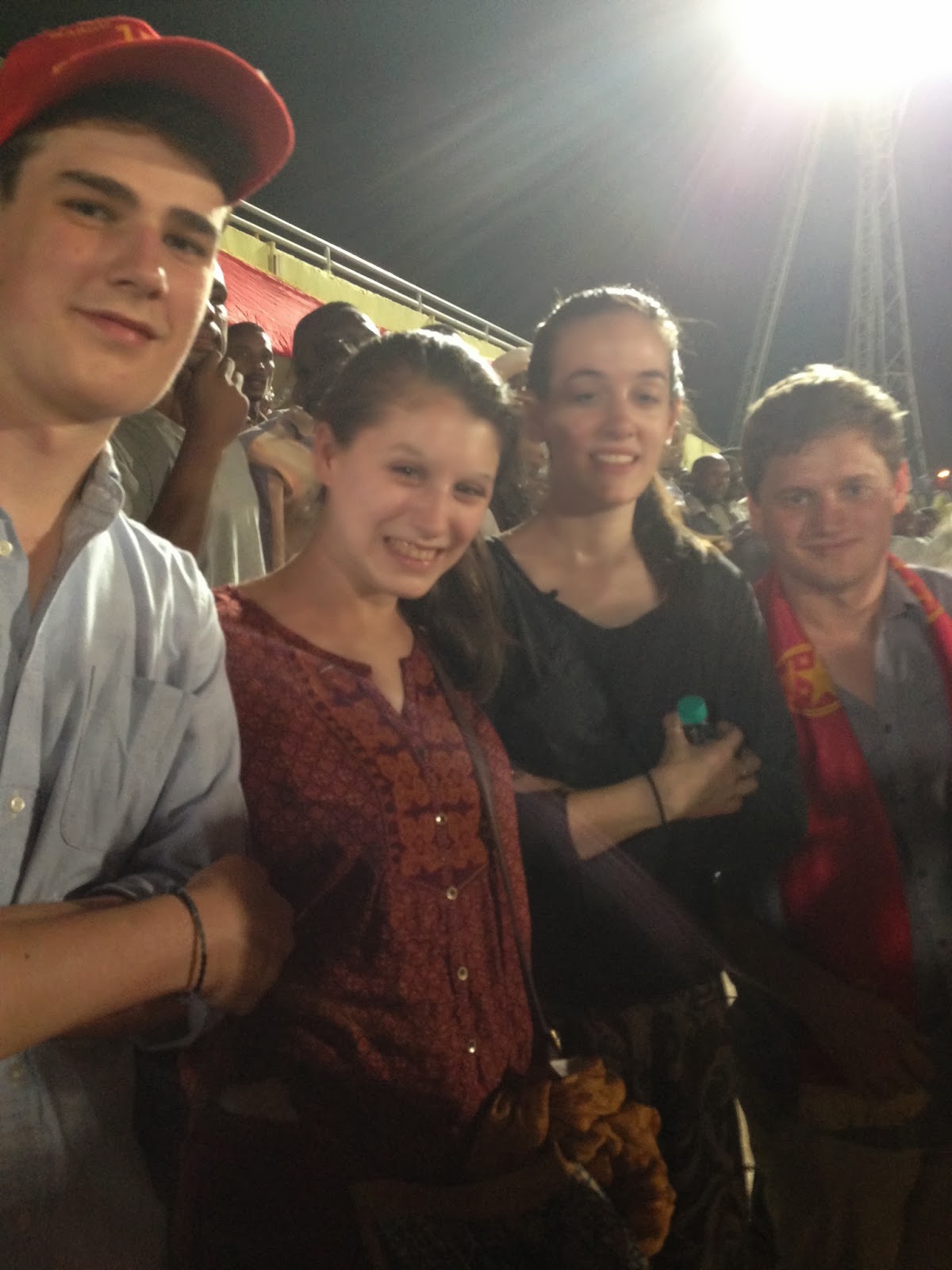
The other night we heard there was a football (soccer) game at the nearby stadium. We asked our Sudanese friend if women could go and he said “Yes ma mushkila” (no problem). Ok great. So together joined by two British guys who had arrived less than a week ago we set off to the stadium.  It is far too hot to play during the day so it was a night game Mars (which is short for something I never quite caught) against Khartoum 3.  Inside the stadium we stopped to take a picture and soon found a crowd of people also wanting a photo…with us. By now I wasn’t really surprised people have starred and even once stopped a friend at tea for a photo, but I hadn’t gone celebrity status till this.  While this could have been an uncomfortable amount of attention in this instance I mostly found the attention funny. The people were soooo happy we came to the game. We made it to the stands where the two guys were whisked off among the crowd and a band cheering and singing. They lifting the boys up on their shoulders and hoisted them around for a while. The rest of the game we watched by the band and cheered when Mars overtook K3 3-1. We even enjoyed a cup of tea during the game. It didn't escape Rachel or I that we were the only women football fans in the entire stadium. The only other women were the sita chai (tea ladies) serving tea.

Did I mention we sat with the band?

Going to the game might be my favorite experience so far. It also opened me up to an important lesson that most restrictions on women are societal norms and not written laws. They are more about social acceptance than what is permissible and what is forbidden. I honestly can’t even do the subject of gender differences justice yet but am going to give it a shot to show my first impressions. Who knows in two weeks or more time I’ll look back on this post and just shake my head.

Kawaja Sudanese Football Fans

There is still a lot I’m learning about Sudanese women. Sad truth is I've only probably talked to a couple dozen or so Sudanese women so far so you can imagine how little my knowledge is about the subject. I did talk CC: football game to one very educated Sudanese woman  who spent some years abroad in Dubai. I wanted her to know I wasn’t trying to say “Because there were no women there Sudanese women must be oppressed” As a white woman who has been in the country for one month and talked to a dozen Sudanese women I have no place to make that statement.

Space is very gendered in Sudan. At night when we would go to an outside restaurant on the side of the street to have some ful (traditional Sudanese meal of refried beans and oil) we noticed there were only men. Even when we went for a big meal at a friend’s family house the women ate together in one room and the men ate in another (and the khawajas ate in another).  Women won’t have tea on the side of the street, but they’ll have it on Nile Street. Generally, more men than women are out and about in the markets. You won’t see groups of women in the market shopping together but you’ll see groups at the indoor shopping mall. At any public space you would find more men than women. This doesn’t mean I never see women in the market or that women “aren’t allowed.” I have even seen, on multiple occasions, a woman ride the bus by herself at night. I have heard a story of a women volunteer who traveled to a place outside Khartoum where she was only allowed to go to market on Sundays and had to be accompanied by a man. I’m still trying to learn what is socially acceptable in Khartoum. Something hard to decode for an outsider is women’s clothing decisions based on where they are going and how they are getting there.

There is a law I’ve been told about that women aren’t allowed to stand on public buses. If all the seats are taken a man is supposed to offer his seat to stand or the woman must wait for the next bus. I’ve seen both of these situations occur. I’ve also seen a group of young women standing on a bus. Women also aren’t allowed to wear pants at public universities.

In my conversation with my Sudanese friend I tried to explain to her that when I told my friends or family back home about the game they would immediately think “something must be wrong if there were no women” “Why aren’t women allowed?” and that there is some injustice “Women must be oppressed in Sudan”. And I can’t say with 100% confidence that they are wrong, but from where I stand it’s not my place to make that judgment.  But Ryan…you might start, women in “these types” of societies have been brainwashed by their “traditional” culture and will never be over to overcome it alone. STOP.

Sudanese women are smart. Some of the few who I’ve met are very educated and have traveled abroad across Africa and to other countries; they know when society is screwing them over. My friend hypothesized with me “Maybe Sudanese women don’t like football.” “Maybe they don’t go because they don’t want to be looked at,” she gestured and I knew she couldn’t find the right words in English. Women shouldn’t have to feel uncomfortable in public space. Yes I agree with you, women in Sudan, the United States, everywhere shouldn’t feel fear in public spaces just because they are women.

No. Just, no.
Generally, women know when they are being oppressed. Women know when they are being treated as second class citizens.  Unfortunately there isn’t much hard data on this topic for the case of Sudan, but there is no doubt in places were civil rights are suffering women are bearing a huge weight of that suffering.  Being an ally to women’s causes which also fly as human rights  is important but I don’t know, actually, talking to these women before you form some opinion on their lives/ culture/ society is better.