Showing posts with label blog. Show all posts

Tuesday, July 1, 2014

Take-Aways/Sahfari*


So it’s July. I’ve made it. In 20 short days I’ll be leaving the place I’ve called home for the last 10 months. In the last month or so I’ve thought about what I’m going to “take-away” from this experience. Its even more refreshing now that some new volunteers have arrived and asked me these questions and what to expect. I’ve thought a lot about how I want to “talk about Sudan” with friends, potential employers, and strangers. I’m definitely searching for a balance.

A farm on Tuti Island overlooking Khartoum
I’ve really been thinking about the way I view and define violence, development, and freedom while I’ve been here. I hope to continue to challenge my and other’s definitions with different cultural interpretations.

Rachel and I have spent countless nights here debating lots of etymology used in International relations and development. The one we could never quite get over was “Developing vs developed country.” Although far better than the other category option of “Third-World,” I think our community of practice owes it to work out better language than this.  It’s problematic. I’m sure there have been far more articulate arguments made about this issue and I urge you to post them in the comments section below.

Some pretty terrible things happened to some people while I’ve been here. For security I’ve not shared those stories on this blog. I’m not going to whitewash those truths when I come home, but at the same time I don’t want my experience to become throwaway anecdotes which minimize some truly horrible  problems in Sudan or make it about “how rough I had it” (EYEROLL) or something that perpetuates or plays into the stereotypes of Sudan which Americans have.


Nile Street at Sunset
I think it’s very hard to simply say any statement saying “Oh well Sudan is like this…” “Sudanese people are like this” The same way when my students ask me about America and I tell them I can’t generalize about all Americans. I’m going to try to take that lesson to heart. 

Ok here are some more pics of what I've been up to this month!
Nas with notepads - a monthly spoken word event

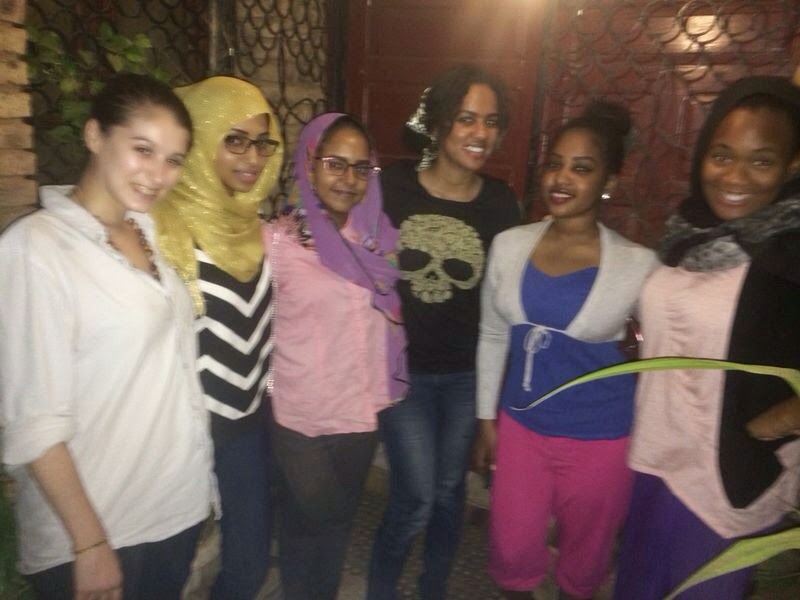
Hanging with some fun ladies for mougrib tea


Henna- a beautiful Sudanese tradition for women before they get married

One of two Mexican restaurants in Khartoum "Amigos" describes itself as Tex-mex

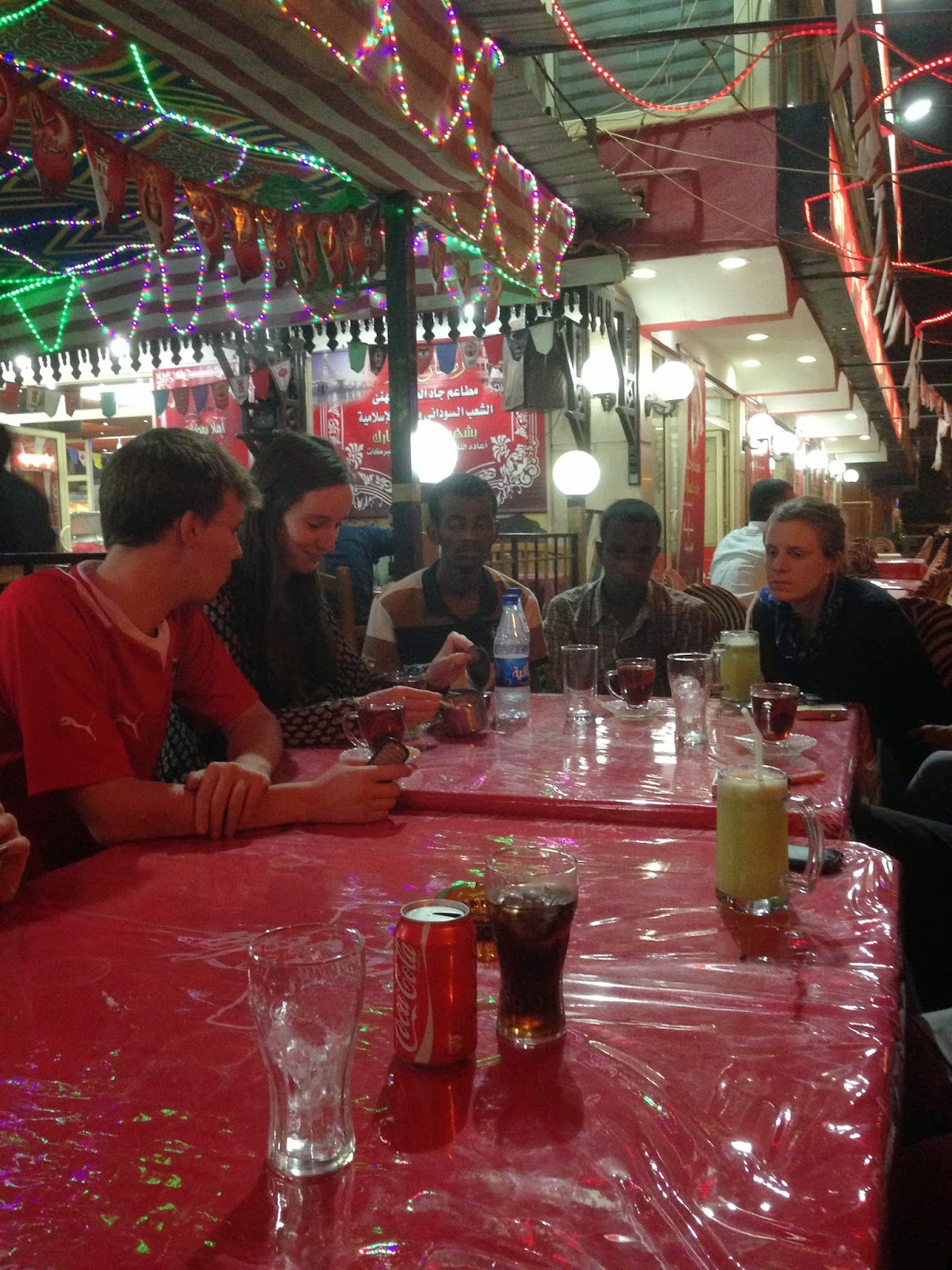
Goodbye dinner at GAD!


*Sahfari (Sah-FA-ri) is the arabic word that is used to get food "to-go" it means take away. Easy to remember because its like  going on a safari

Tuesday, May 27, 2014

Kassala for Beginners


"Kassala, Mashallah, Humdallah"


I feel I must backtrack and offer you all some description on my wonderful trip I took to Kassala (Cuss-a-lah) in the East of Sudan back at the end of March. Honestly I’m so incredibly grateful that Rachel and I found the time to travel.
Sunset over Kassala

Our journey to Kassala  began very early in the morning. Luckily our friend helped us navigate the bus station at Mina Burri. It was a pretty hectic scene, so we were happy to find our bus and attempt to go back to sleep. The bus ride from Khartoum to Kassala is 8 hours. The buses are large coach busses, with tvs and AC. Ours was decorated with orange fringe, fur, and beading everywhere.
We arrived and were met by our good friend and fellow volunteer who is teaching at the University of Kassala. Even though he, himself, had only shortly just arrived he would be our tour guide while we were visitng. Also another friend arrived the night before from Port Sudan.

First glimpse of Kassla on the local bus into town
The first thing I noticed about Kassala were the mountains. Beautiful rocky mountains that do, indeed have, as my guide book described, an “other-worldliness” way about them. The second thing I noticed was that it was considerably hotter in Kassala. The heat hit me like a wall getting off the bus. This was back in March too, when I was still asking Sudanese friends when it would get hot again. Well, I had my answer.

The heat was bad like, bad-bad. But the scenery and company was too good.

View of Mountains from the University of Kassala
The center of Kassala has plenty of juice stands. They were round or hexagon shaped and reminded me of touristy food or lemonade stands in beach towns. Much to our surprise Kassala seemed much cheaper than Khartoum. Not surprising was that Kassala was much smaller and had much fewer people who spoke English. I also saw people of different ethnic groups and tribes that are less present in Khartoum. Of course we saw many Beja men, dressed in their classic uniform, a jalabiya with a vest over it and Rashida women who distinctly dress in black velvety robes/gowns with red beading and their veils covering their mouths.
Teapot gated entrance to Totiel 
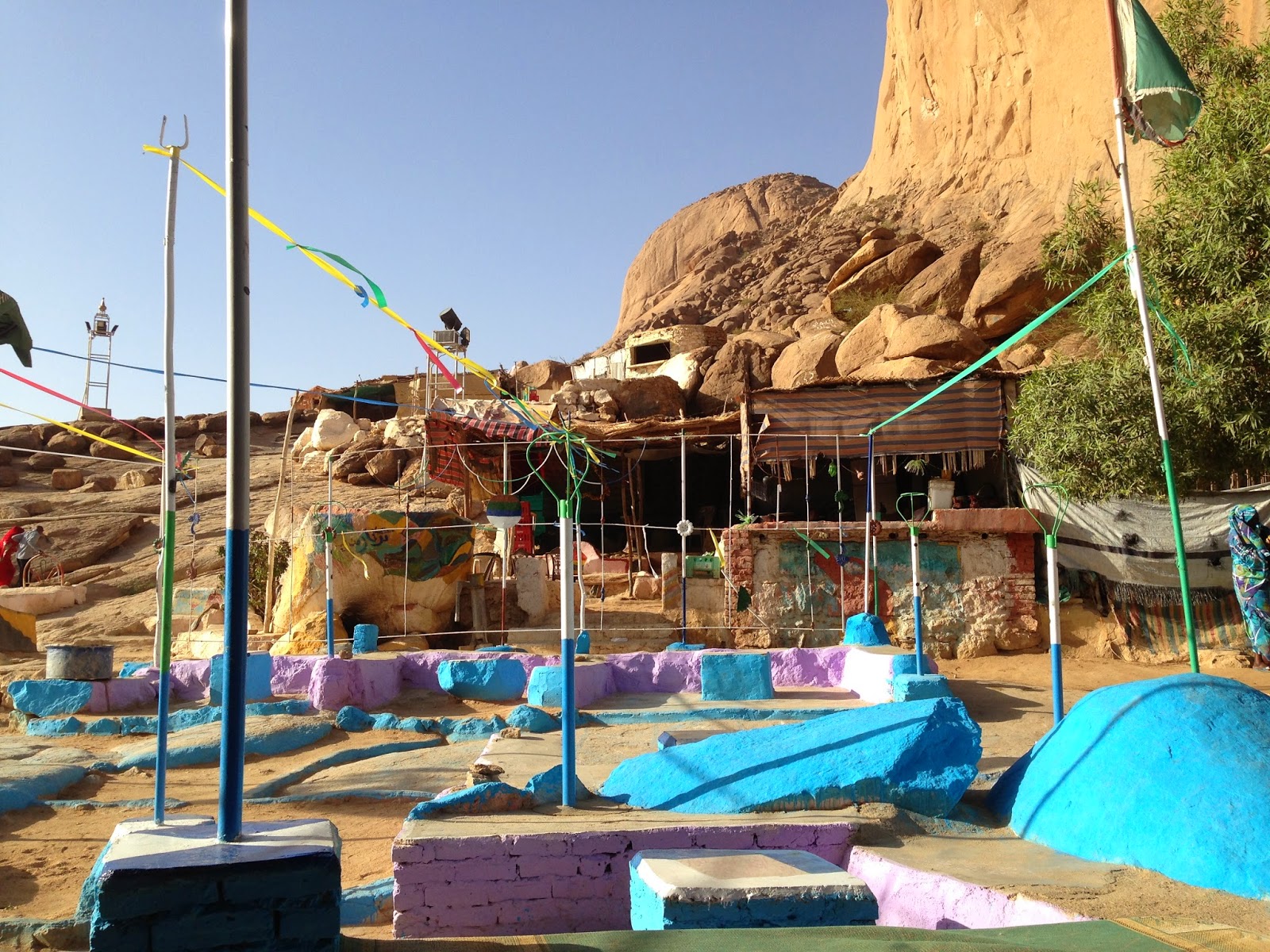
During the trip we visited Totiel, at the base of the Taka Mountains. This is a frequent spot for honeymooners and other Sudanese on vacation. Many coffee and tea huts are set up or even carved in at places at the base of the mountains. The have painted the rocks and decorated the area so it is quite festive. My favorite part of Kassala was having coffee and popcorn (served together like in Ethiopia) at Totiel while watching the sun set over the town. We also people-watched looking at the newlyweds, the women in their finest beaded tobes with beautiful henna on their hands and feet. We tried to assess which couples seemed the happiest and which women were fairing the best in their clunky wedged high heels on the mountainside. The next day the members of my group were determined to climb part of the mountain to see Eritrea on the other side. I was determined not to pass out from the heat just from being outside.* So, I passed. I didn’t pass on drinking from the well at the base of Toteil. The well is said to promise good fertility (here’s looking at you, honeymooners) and that visitors will return to Kassala.


Coffee hut on Totiel

The well
Toteil coffee huts empty which would fill with people before the sunset


How I creepily took a pic of honeymooners

The pot is called a jebana
Coffee  is also called Jebana so you order a "jebana fi jebana" served with salty popcorn and incense 
 We also visited the Khatmiyah Mosque also located at the base of the Taka Mountains.


Our other time in Kassala was spent checking out different souqs (markets), parks, and walking through some mango farms to the Gash riverbed. 


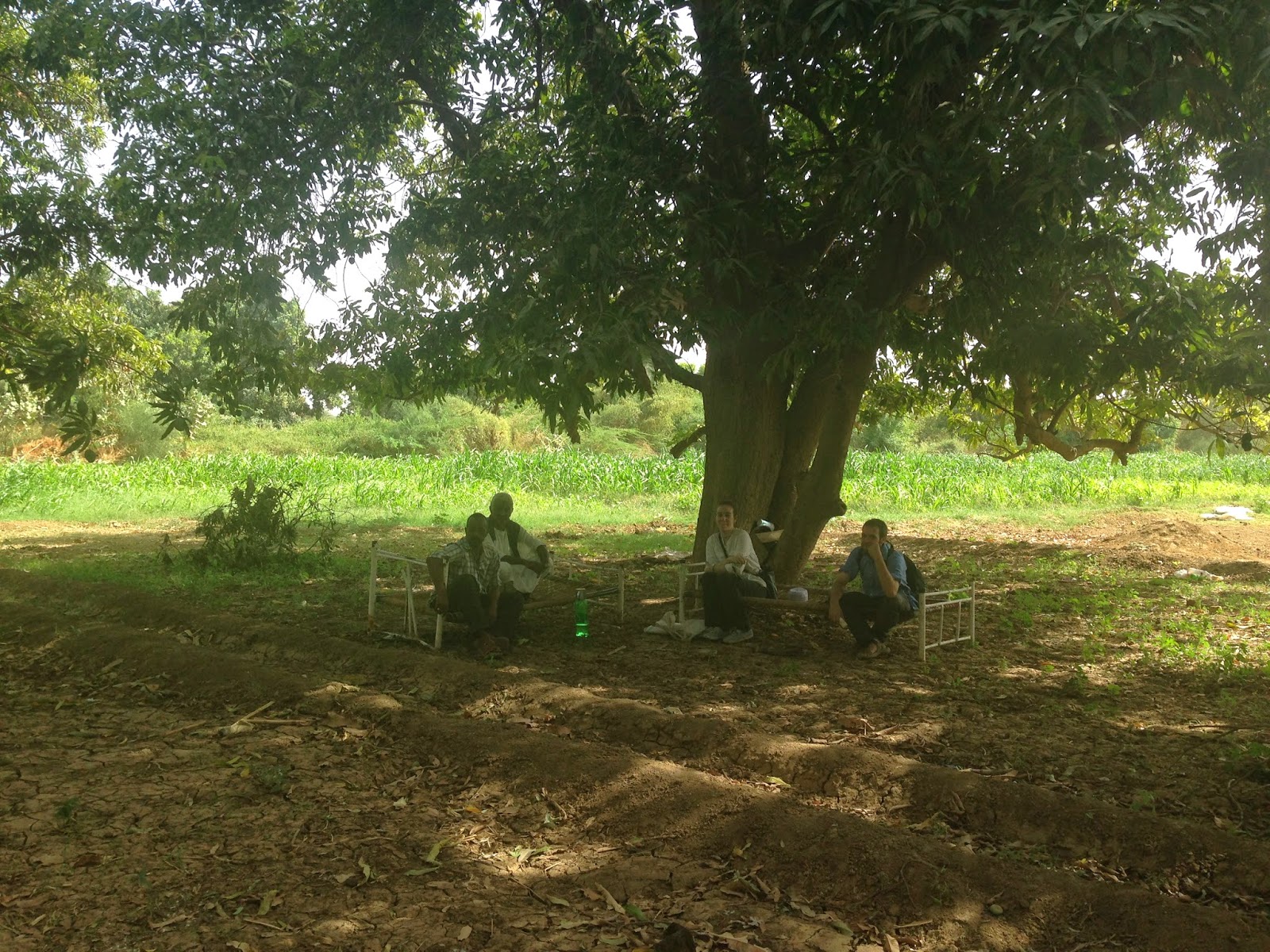
Stopped to splash ourselves with water from an irrigation pump in the mango grove
 Of course when a family found us wandering around in their farm they offered us, to rest with them and their kids got us some fruit.


Overall it was a wonderful trip. Even in the heat it was nice to get out of Khartoum, explore nature, and see different cultures. I highly recommend it for anyone traveling to Sudan. 

*Also contributing was my lack of mountain climbing footwear and clothing. Have you ever climbed a mountain in a skirt? You can assume it's not a great idea. 

Thursday, May 22, 2014

Teacher Musings and How to Deal with the Heat


I realized I haven’t given a life update in some time and so it’s probably only fair to write about what I’ve been up to. A lot has happened! I moved from Bahri (Khartoum North) to Manchea*, a neighborhood in center of Khartoum. I moved because Rachel and I received a new university placement at Comboni College. We live much closer to Nile Street and “all the action” Khartoum has to offer, though we do miss the tightly-knitted neighborhood of Safia and our favorite neighbor Haj Safie at times.

Our  kitchen where our signature dish pasta and Mish** tomato sauce is made

Camboni College has a really interesting history. It was started as a primary school by missionaries but has since scaled up.  It is named after, Daniel Camboni,  the first Catholic Bishop of central Africa, who worked as an Italian missionary The school administration worked with the Ministry of Education and now offer 4 Bachelor’s programs in some sort of public/private partnership. They also offer "after-school" English, Spanish, and Italian short-term courses. There is a church at the Souq Arabi campus and all the secondary students wear lavender blouses and headscarfs for girls, with black bottoms. It is pretty amazing that their campus is located right around the corner from “the big mosque” in the center of Souq Al Arabi. Many students of all different backgrounds attend classes at Comboni. The classes I teach are short-term private classes which are small and grouped by level. They are much more manageable than my 80-100 group of rowdy 17 year olds at Bahri University. This has had a huge effect on my feelings about teaching and my spirits in general.

We haven’t been without problems, but overall the administration of the school is the most organized I’ve been involved with or potentially heard about here. Our coordinator is an incredibly bright young Sudanese woman who splits her time running the short term courses for Comboni and running an oncology clinic. She speaks fluent Italian and English and is taking Spanish courses. Honestly regardless of the frustrations we have, this woman runs a tight ship and is an inspiration.

The terrace across the street from Khartoum University where I taught my private class
I was also teaching private classes associated with Khartoum University that just wrapped up in April. If you’ve been following the politics there, I’d add it finished just in the nick of time although I’m saddened by the university’s closure. I really enjoyed this group of students. At the end of our class we even took a class trip to Jebel Aulia, about an hour south from Khartoum on the White Nile, to have a picnic of fried fish.


Students exploring the dam
Boat ride on a fishing boat by our picnic spot
We have decided to hold our own English club on Nile Street twice weekly. Nothing like having a hot cup of tea on the side of the road in 100°F heat. I can’t actually believe I got this far into discussing my life without mentioning that Summer is killing me!

A spot along Nile Street by the "India Bridge" to Bahri

Nile Street!
It’s hot hotter even hotter now. Always. There isn’t much else to say. The heat has made many of the volunteers, including myself, more anti-social. People don’t want to leave their homes, which is fair. Staying in seems to be one of the best ways to cope. I feel like I should have learned more tricks of the trade by now, but really, I only have a short list with a few of the lame ways we have coped with the heat.
1.)    Drinking water
2.)    Putting our sheets in the freezer
3.)    Standing in front of the fridge while it is open
4.)    Multiple showers daily
5.)    Drinking more water
6.)    Holding a water bottle like it’s a baby.
7.)    Naas Pizza delivery (ah-mazinggg BTW)

Like I said not a very impressive list, but hey, I think we’re doing alright, for ourselves. 


The glory that is Naas's "Ethiopian Pizza"

*Currently polling the English spelling of the neighborhood as I've seen it Manchea, Manshiya, and Manshia.

**My googleing in English failed to produce a good picture but for all intensive purposes Mish is like yogurt veggie dip

Tuesday, February 11, 2014

The Social Scene in Khartoum: Concerts, Culture, and Dancing


Upon coming to Sudan I was warned that it doesn’t exactly have a vibrant social scene, in the traditional Western sense. I was told of course there arn’t movie theaters*, concerts are limited, and there isn’t exactly night life. My social life in Sudan has proved much of this to be quite contrary. I’ve frequented concerts, parties, and stayed out very late on Nile Street. This can’t be attributed to getting on the inside of the Khartoum expat social scene either, as Rachel and I have happily found ourselves slightly outside that circle. Rather the past couple weeks I’ve had my fair share of exposure to Sudanese culture and entertainment through several festivals. There have been really great events.


First Sudan Film Factory partnered with a number institutions including the Goethe Institute (German cultural institute) and hosted Sudan’s First Independent Film Festival. How great is this? I was lucky enough to get my name on the list for the opening night. On opening night there was a screening of “Faisal Goes West” a short film about a family who emigrated from Sudan to Texas. You can watch the trailer here because I’m about it SPOILER ALERT in my experience and review of it. I loved that the film maker chose to tell this story framing it around the struggle of immigrants and not making it about refugees. There is even a line “Darfur. Yeah we aren’t from there.” It was also super interesting to watch the film as an American in an audience full of Sudanese. In many ways America is still “a big dream” for many Sudanese who I’ve talked with. Rachel and I estimated about 3 out of every 10 Sudanese friends or colleagues have told us they applied for the lottery. The movie does have its cringe-worthy moment where Faisal runs into some guys that jump him. Obviously I don’t want my Sudanese friends to think that if they come to American they are going to be attacked or robbed and that we have become an intolerant society of outsiders in America so yeah my initial reaction was a sarcastic “oh great”. Upon reflection though I think the scene, clearly the climax of the film, speaks symbolically about the difference between perception and reality of the typical immigrant’s journey. Anyway it’s a great film you’ll laugh, you’ll cry, you’ll wonder if there really are still chicken farms in Texas.

          After the movie there was a great performance by Dina Al Wadi a French-Egyptian Singer who wore a hot pink mumu type dress. She even sang some Sudanese songs of which the crowd loved and sang along with. I think she was the most talented singer I’ve seen perform in Sudan.


          Anyway I went to an additional screening of another film though the festival screened maybe up to a dozen and generally think the film festival was a success so that’s really great. Additionally there was a Sudanese Cultural Festival hosted by the Sudanese National Museum and co-sponsored by the British Council. During this festival I attended two concerts. One showcased a local Reggae band and the following night a British Dub-Reggae Band (cause apparently that’s a thing now) performed.  I think I’ve mentioned before that many Sudanese love reggae music. At one point one of the nights hosts made the claim that reggae music started in East Africa…a claim which definitely raised an eyebrow or two. The concerts ended at 11 due to a noise curfew or something. While generally I don’t want to put down these types of events I was scratching my head a bit at the fact that a British band was headlining the final night of a “Sudanese” cultural festival. To the organizers’ credit for a few songs some local artists joined the band on stage.
It could have been an off-hand remark but my friend Mohammed turned to me during Dina al-Wahi’s performance and said that because there was such an international crowd she should sing some American music. I get the impression that Sudanese culture isn’t perceived as “special” or “good enough” and was reminded of this again with the British band incident.

     
          As far as entertainment between festival based events (and there seems to be a festival of some sort every month) there are several restaurants that have live-singers on Thursday nights. One of which is a popular Souq Al-Arabi restaurant called Papa Costas. All I can say is I’m still recovering from my experience dancing and listening to the band play everything from “Hotel California” to popularized Arabic music to a Tom Jones inspired take on “Yesterday” and I don’t think any amount of words could fully describe my night there, but it was definitely fun and unexpected.


Finally not to leave out one of the more glamorous nights out I most recently attended a very lovely party at the German residence located at a Nile front property.


*The newly opened Afra Mall has a theater showing Egyptian movies 

Saturday, November 16, 2013

White Girl Goes to Africa, Isn't Trying to Save Anybody


Let’s get one thing straight. My experience in Sudan is entirely shaped by the privilege that I’m a white woman. This privilege has affected my time here so far both positively and negatively. It is interesting because at times socially acceptable behavior for being white and at the same time a woman are at tension with one another. Sometimes there isn’t space for being a white woman.

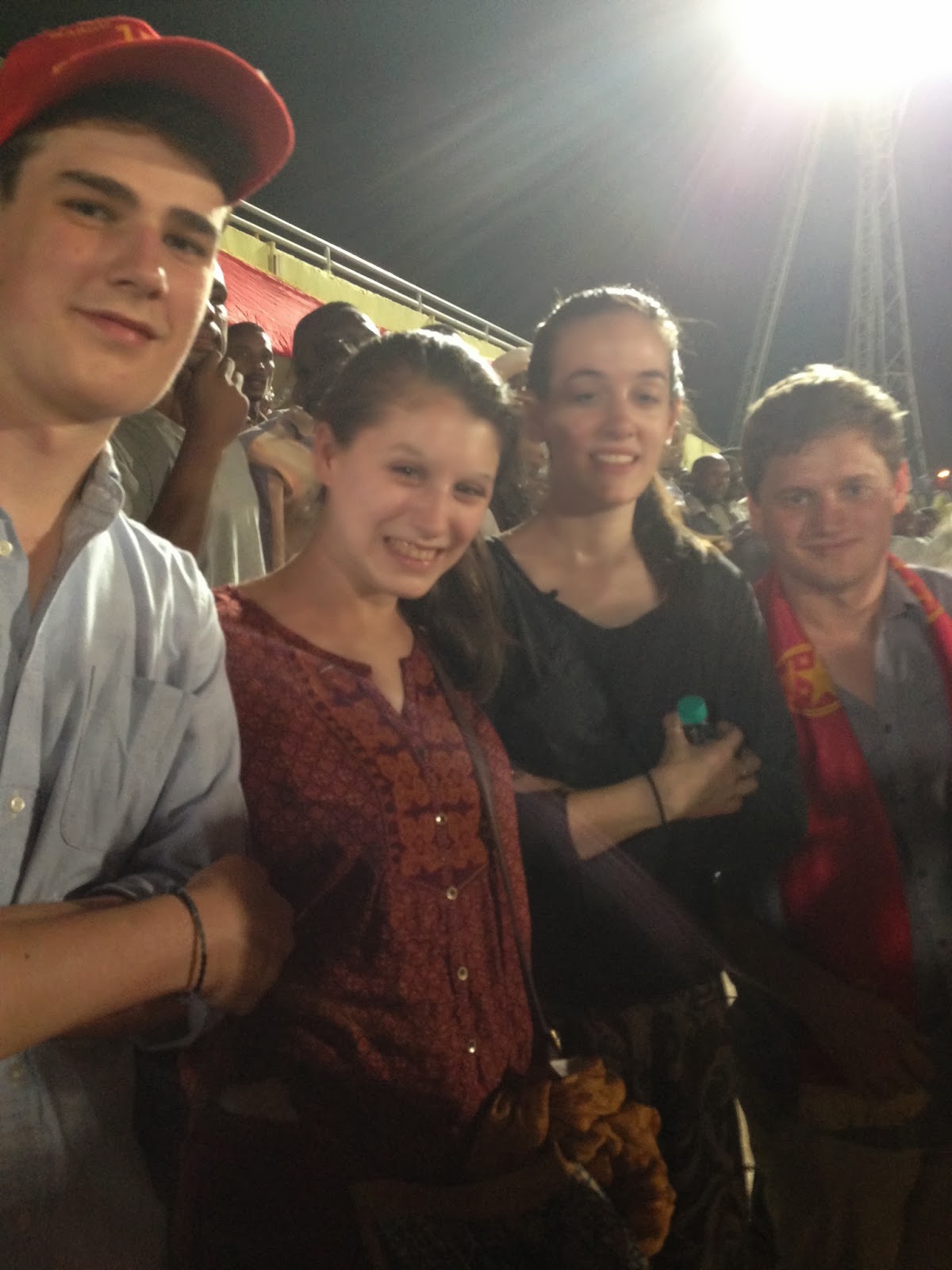
The other night we heard there was a football (soccer) game at the nearby stadium. We asked our Sudanese friend if women could go and he said “Yes ma mushkila” (no problem). Ok great. So together joined by two British guys who had arrived less than a week ago we set off to the stadium.  It is far too hot to play during the day so it was a night game Mars (which is short for something I never quite caught) against Khartoum 3.  Inside the stadium we stopped to take a picture and soon found a crowd of people also wanting a photo…with us. By now I wasn’t really surprised people have starred and even once stopped a friend at tea for a photo, but I hadn’t gone celebrity status till this.  While this could have been an uncomfortable amount of attention in this instance I mostly found the attention funny. The people were soooo happy we came to the game. We made it to the stands where the two guys were whisked off among the crowd and a band cheering and singing. They lifting the boys up on their shoulders and hoisted them around for a while. The rest of the game we watched by the band and cheered when Mars overtook K3 3-1. We even enjoyed a cup of tea during the game. It didn't escape Rachel or I that we were the only women football fans in the entire stadium. The only other women were the sita chai (tea ladies) serving tea.

Did I mention we sat with the band?

Going to the game might be my favorite experience so far. It also opened me up to an important lesson that most restrictions on women are societal norms and not written laws. They are more about social acceptance than what is permissible and what is forbidden. I honestly can’t even do the subject of gender differences justice yet but am going to give it a shot to show my first impressions. Who knows in two weeks or more time I’ll look back on this post and just shake my head.

Kawaja Sudanese Football Fans

There is still a lot I’m learning about Sudanese women. Sad truth is I've only probably talked to a couple dozen or so Sudanese women so far so you can imagine how little my knowledge is about the subject. I did talk CC: football game to one very educated Sudanese woman  who spent some years abroad in Dubai. I wanted her to know I wasn’t trying to say “Because there were no women there Sudanese women must be oppressed” As a white woman who has been in the country for one month and talked to a dozen Sudanese women I have no place to make that statement.

Space is very gendered in Sudan. At night when we would go to an outside restaurant on the side of the street to have some ful (traditional Sudanese meal of refried beans and oil) we noticed there were only men. Even when we went for a big meal at a friend’s family house the women ate together in one room and the men ate in another (and the khawajas ate in another).  Women won’t have tea on the side of the street, but they’ll have it on Nile Street. Generally, more men than women are out and about in the markets. You won’t see groups of women in the market shopping together but you’ll see groups at the indoor shopping mall. At any public space you would find more men than women. This doesn’t mean I never see women in the market or that women “aren’t allowed.” I have even seen, on multiple occasions, a woman ride the bus by herself at night. I have heard a story of a women volunteer who traveled to a place outside Khartoum where she was only allowed to go to market on Sundays and had to be accompanied by a man. I’m still trying to learn what is socially acceptable in Khartoum. Something hard to decode for an outsider is women’s clothing decisions based on where they are going and how they are getting there.

There is a law I’ve been told about that women aren’t allowed to stand on public buses. If all the seats are taken a man is supposed to offer his seat to stand or the woman must wait for the next bus. I’ve seen both of these situations occur. I’ve also seen a group of young women standing on a bus. Women also aren’t allowed to wear pants at public universities.

In my conversation with my Sudanese friend I tried to explain to her that when I told my friends or family back home about the game they would immediately think “something must be wrong if there were no women” “Why aren’t women allowed?” and that there is some injustice “Women must be oppressed in Sudan”. And I can’t say with 100% confidence that they are wrong, but from where I stand it’s not my place to make that judgment.  But Ryan…you might start, women in “these types” of societies have been brainwashed by their “traditional” culture and will never be over to overcome it alone. STOP.

Sudanese women are smart. Some of the few who I’ve met are very educated and have traveled abroad across Africa and to other countries; they know when society is screwing them over. My friend hypothesized with me “Maybe Sudanese women don’t like football.” “Maybe they don’t go because they don’t want to be looked at,” she gestured and I knew she couldn’t find the right words in English. Women shouldn’t have to feel uncomfortable in public space. Yes I agree with you, women in Sudan, the United States, everywhere shouldn’t feel fear in public spaces just because they are women.

No. Just, no.
Generally, women know when they are being oppressed. Women know when they are being treated as second class citizens.  Unfortunately there isn’t much hard data on this topic for the case of Sudan, but there is no doubt in places were civil rights are suffering women are bearing a huge weight of that suffering.  Being an ally to women’s causes which also fly as human rights  is important but I don’t know, actually, talking to these women before you form some opinion on their lives/ culture/ society is better.